Kamisama 神様 · Episode 01 · Japanese Shrine Guide
神 様 社 鳥 居
Japan’s Hidden
Sacred World
What Is a Shrine — and Why Does It Feel Like Magic?
Shinto & Culture · 8 min read · Beginner Friendly
Opening
Hidden in the middle of a busy city, behind a simple red gate, there is a completely different world waiting for you — and you are about to discover it.
Section I
A Gateway to Another World
Picture this: you are walking down a packed street in Tokyo — the noise, the crowds, the endless blur of neon signs. Then suddenly, between two ancient trees, you see it. A towering vermillion red gate standing tall and silent. You step through it, and everything changes.
The sounds of the city soften. The air feels cooler, fresher, almost electric. The street is still right behind you, just meters away — but somehow it feels like you have stepped into an entirely different world. That is not your imagination. That feeling is real, and it has a name.
✦ Sacred Boundary — 結界 Kekkai
In Japanese, kekkai (結界) means “sacred boundary.” The torii gate is not just a beautiful entrance — it is a spiritual threshold that separates the ordinary world (俗界, zokkai) from the divine world (聖域, seiiki). The moment you cross it, you are officially stepping onto sacred ground.
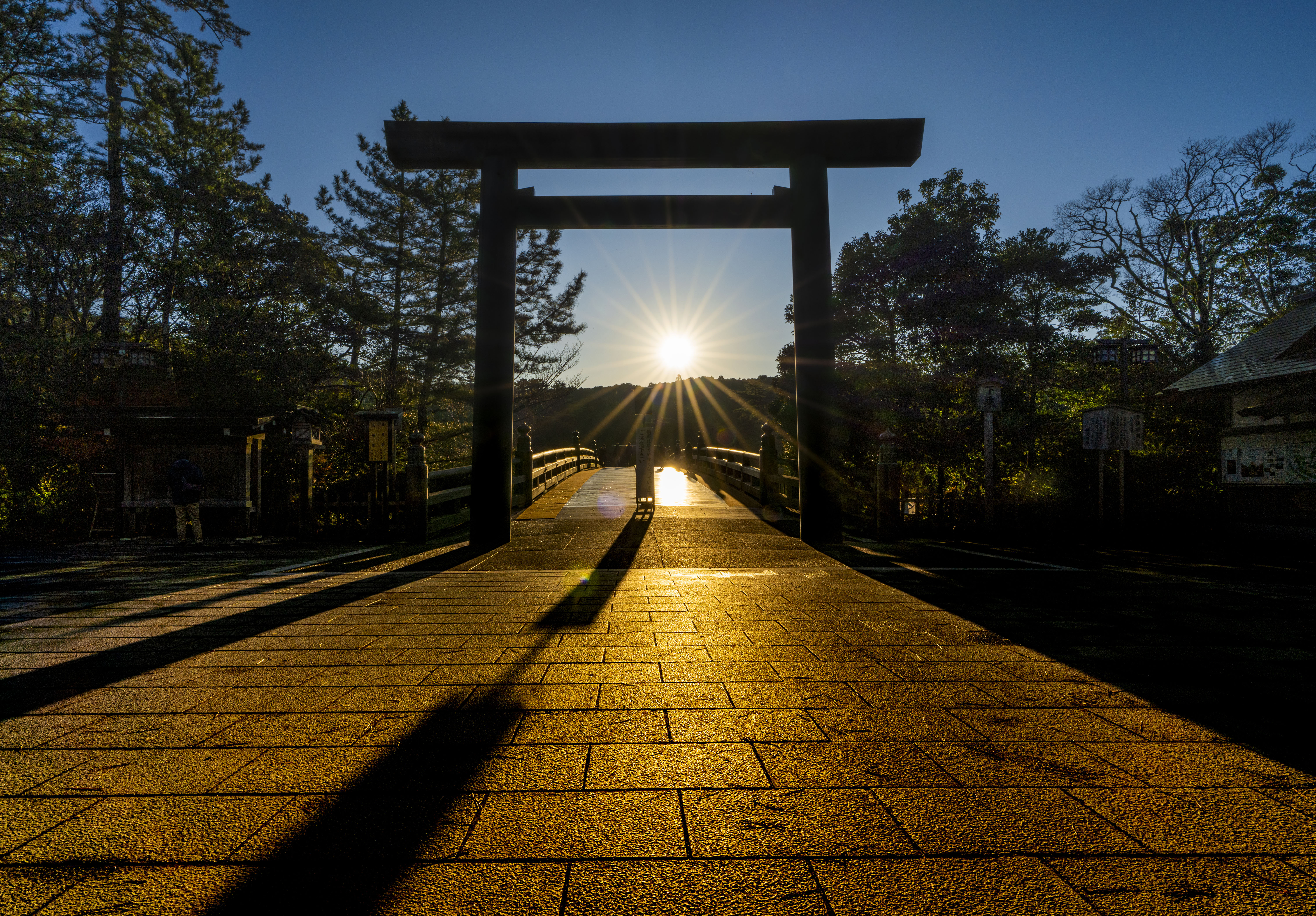
This is one of the most beautiful and unique things about Japanese shrines. Unlike many religious sites around the world that feel distant or solemn, shrines are woven right into everyday life. You find them tucked inside busy neighborhoods, hidden in bamboo forests, perched on mountain peaks, and even nestled on the rooftops of modern department stores.
✦ Mind-Blowing Fact
Japan has over 80,000 shrines — more than the number of convenience stores in the entire country. There is almost certainly one within walking distance of wherever you are standing right now.
Each of these 80,000 shrines has its own history, its own deity, its own unique atmosphere. Some are grand and famous, drawing millions of visitors. Others are tiny stone altars barely bigger than a mailbox, tended quietly by local residents for centuries. But they all share that same feeling when you step through the gate — a sense of entering somewhere truly special.
神
Section II
The Spirit of Shinto
To really understand shrines, you need to understand Shinto (神道) — and do not worry, it is not as complicated as it sounds. Shinto is Japan’s oldest spiritual tradition, and once you grasp the core idea, everything about shrines will suddenly start to make perfect sense.
Here is the central idea of Shinto, and it is genuinely beautiful: everything in nature has a spirit. The ancient cedar tree in the forest, the waterfall on the mountain, the ocean waves, the wind that moves through the grass — all of it is alive, and all of it is sacred. These spirits are called kami (神).
✦ The Heart of Shinto
This worldview is sometimes called animism — the belief that the natural world is filled with spiritual presence. But Shinto goes further. It is not just about nature being spiritual. It is a whole way of seeing the world: humans are not separate from or above nature. We are part of it, connected to it, responsible for living in harmony with it.
Shinto has four core values that shape everything about how shrines work and why they feel the way they do:
🌸
Purity
清め
Cleansing body and spirit before entering sacred spaces
🙏
Gratitude
感謝
Giving thanks to nature and the kami for life’s blessings
🌿
Harmony
和
Living in balance with nature, not dominating it
🎋
Sincerity
誠
Approaching the kami with an honest, open heart
One more thing that makes Shinto unusual: there is no holy book, no single founder, no strict set of rules about what you must believe. Shinto is less about doctrine and more about feeling — about cultivating a deep, genuine connection to the natural world and the divine spirits that inhabit it. Many Japanese people do not even think of Shinto as a “religion” in the Western sense. It is more like a way of life, woven into the rhythm of the seasons and the landscape itself.
✦ Did You Know
Shinto has no sacred text equivalent to the Bible or Quran. Instead, it is passed down through rituals, festivals, and the shrines themselves. The shrines are the living scripture of Shinto.
社
Section III
Eight Million Gods
Here is where things get wonderfully, beautifully strange. In Shinto, there is not one god, or two, or even a handful. There are yaoyorozu no kami (八百万の神) — literally translated as eight million gods.
In ancient Japanese, “eight million” (八百万, yaoyorozu) did not mean exactly 8,000,000 — it meant “an uncountably vast number.” The point is that kami are not rare, distant beings. They are everywhere. In every river, every forest, every rock, every storm. The world is absolutely overflowing with them.
✦ Sacred Knowledge
The word kami (神) is often translated as “god” but carries more nuance. A kami can be a mighty creator deity, a gentle local spirit, or even the divine essence within a remarkable human being. It is less about power and more about sacred presence.
Some kami are ancient and powerful, governing the great forces of nature. Others are modest local spirits watching over a single neighborhood or mountain. Here are some of the most beloved kami you may encounter at shrines across Japan:
天照大御神
Amaterasu
Goddess of the Sun. The most important kami in all of Shinto.
稲荷大神
Inari
God of harvest, foxes and prosperity.
雷神
Raijin
God of Thunder and Lightning.
大国主命
Ōkuninushi
God of relationships and destiny.
綿津見神
Watatsumi
God of the Sea. Patron of sailors.
木霊
Kodama
Spirits living inside ancient trees.
Wait — I Have Seen These in Studio Ghibli Films
The tiny white bouncing spirits in Princess Mononoke? Those are kodama (木霊) — real tree spirits from Shinto tradition. The giant camphor tree in My Neighbor Totoro? A sacred goshinboku (御神木) — a divine tree believed to house a kami. Miyazaki grew up with Shinto, and his films are absolutely filled with these spirits.

This is what makes visiting shrines so extraordinary. Every single shrine in Japan is dedicated to specific kami — and those kami have their own personalities, their own stories, and their own powers. When you visit a shrine, you are not just seeing architecture. You are visiting the home of a god.
鳥
Section IV
Why Shrines Still Matter Today
Here is what surprises most visitors: shrines are not relics of the past. They are not historical monuments that Japan simply maintains out of tradition. They are living, breathing, actively used sacred spaces — woven into the fabric of Japanese life today, in the same way they have been for over a thousand years.
3M+
People visit Meiji Shrine in Tokyo during New Year’s — in just the first three days of January
80K
Shrines across Japan, each maintained and actively visited by local communities today
1,300+
Years the Ise Grand Shrine has been ritually rebuilt every 20 years
Japanese people visit shrines to mark almost every important moment in life — New Year’s (初詣), a baby’s first visit (お宮参り), Shichi-Go-San (七五三), prayers before exams (合格祈願), wedding ceremonies, prayers for health, car safety blessings, and spring festivals. The list is endless.
✦ Extraordinary Tradition
The Ise Grand Shrine has been ritually rebuilt every 20 years for over 1,300 years. The current structure was last rebuilt in 2013. This practice ensures both the preservation of ancient craftsmanship and the symbolic renewal of the divine. It is one of the most extraordinary living traditions in the world.
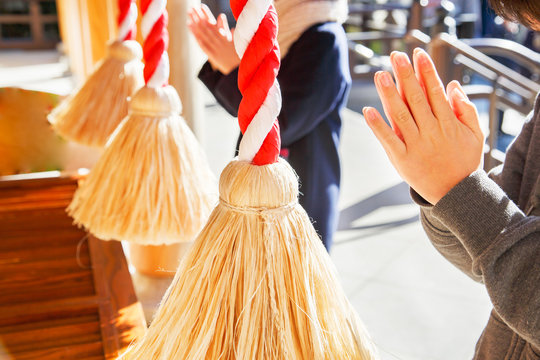
When you visit a shrine, you are not a tourist observing a display from the past. You are a participant in an unbroken living tradition that has connected human beings to the natural world and the divine for over a thousand years. That is not history. That is something extraordinary — and it is waiting for you behind the very next torii gate you walk through.
Coming Next — Episode 02
How to Actually Visit a Shrine
(Without Embarrassing Yourself)
The torii, the water ritual, the bow, the clap, the prayer — we will walk through every step together so you can visit any shrine in Japan with total confidence.
Subscribe on Substack →
Written by
sHiNji
⛩ Shrine Maniac🗾 Based in Japan📜 Jinja Kentei Certified
A self-confessed shrine obsessive currently living in Japan. sHiNji holds the Jinja Kentei (神社検定) — Japan’s official shrine knowledge certification — and has spent years exploring shrines from the towering gates of Fushimi Inari to forgotten stone altars deep in mountain forests. Kamisama is his attempt to share that obsession with the world, one episode at a time.
Kamisama — Japanese Shrine Guide — Episode 01
 Kamisama 神様 · Japanese Shrine Guide・Episode 02
コメントを残す